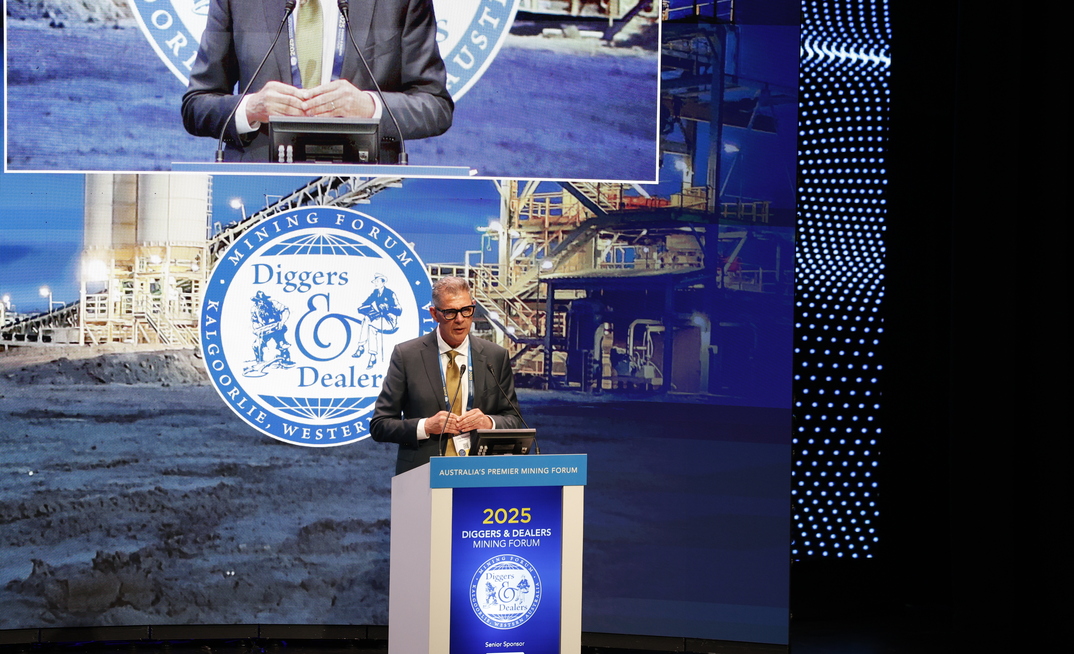


Something has changed in the lithium space at the 2025 iteration of the Diggers & Dealers Mining Forum in Kalgoorlie.
Make no mistake, the market's still broadly the same: oversupplied and in a price-stricken, Game of Thrones-esque ‘winter'.
But the vibe is different. There's a tinge of optimism in the air.
Lithium bosses — sparse in number but strong in spirit — are talking about how they can comfortably survive the cycle with their robust balance sheets, world-class assets, tier-one locations, high-grade ore, strategic visions, et cetera, et cetera…
YOU MIGHT ALSO LIKE
But this year, delegates believe them.
Or at least, it feels that way.
I'd never suggest you base your investment decisions on a ‘vibe', but if last year's lithium vibe was "it's so over", this year's is trending towards "we're so back".
So… what's changed?
From an operational perspective, the two biggest lithium players on the Diggers roster, Pilbara Minerals and Liontown Resources, have ticked some important boxes since last year's event.
Liontown has officially opened and continued to ramp up its Kathleen Valley mine, which is a few months away from moving entirely underground, and PLS has completed its big P1000 expansion at Pilgangoora and shored up its supply capacity.
While both have faced some challenges, it seems like the riskiest part of mine development and expansion has passed.
It's the macroeconomic outlook, however, that seems to be shifting, if only slowly.
Canaccord Genuity in July published a more optimistic outlook for the lithium space than other capital markets firms, suggesting its previous forecasts were perhaps too conservative.
CBA followed two weeks later, also suggesting prices had finally bottomed.
Others — such as Scotiabank and Daiwa Capital Markets — remain bearish, but it seems some market watchers are starting to align with the message that lithium producers have been saying for years: the market has to turn; at a fundamental level, these low prices are unsustainable.
Demand is growing — and fast
Canaccord's Tim Hoff, speaking to MNN in the main tent at Diggers, said after lithium prices "fell off a cliff" two years ago, there followed a severe lack of investment into new supply.
Meanwhile, demand has grown at a faster pace than many anticipated.
Hoff said on Canaccord's numbers, lithium demand was growing at a rate of 200,000 tonnes of lithium carbonate equivalent per annum. Another way of looking at it is that the market needs a new 1.4Mtpa spodumene facility every year at current demand growth levels.
For reference, PLS produced 755,000t of spodumene concentrate in FY25 — meaning the market demands nearly two PLS' worth of new supply per year.
"If we don't get that investment every single year, we fall behind … and we haven't seen that level of investment two years," Hoff said.
"The lithium price today will not support supply growth, full stop. So, by definition, it has to get better."
The latent elephant in the room
Last year, much of the talk around the lithium market had to do with the idea of ‘latent capacity', or supply that is lying dormant and ready to be brought online as soon as prices rise to an appropriate level.
By and large, analysts were saying that yes, demand was rising and prices would increase, but so many projects and sources of future supply had been put on care and maintenance that as soon as prices rose, these would be rapidly developed — once more oversupplying the market and pushing prices back down.
Wood Mackenzie in May said: "The rapid pace at which supply is exceeding demand could lead to pricing pressures and create long-term market instability unless corrective actions are taken."
In a bleak outlook for the lithium sector, the firm said it expected the market to remain oversupplied until the 2030s.
Hoff, however, said the assets that had been shuttered in the pricing glut hadn't received adequate investment or been fully maintained as companies preserved cash.
While they were once ready to be brought into production in half a year or less, it would now take much longer to add extra supply to the market.
"Around 12 to 18 months ago, if pricing any kind of recovery, latent capacity came back within three to six months. But capital hasn't been spent; assets haven't been maintained," Hoff said.
"Right now, the runway to bring back latent capacity is six to 12 months.
"And it doesn't come cheap, either."
So, yes, he said, latent capacity remains — it's just not going to be quick and easy to turn it on.
Orange man bad?
This all begs the question: why does Canaccord's outlook now contrast with what analysts have been saying for the past year?
Hoff said a lot of it came down to the Trump effect.
American electric vehicle sales, he said, had stagnated. Donald Trump had sparked some commentary around "the death of EVs" — especially following his fallout with Elon Musk and the perceived effect that would have on Tesla.
But the rest of the world, Hoff said, was adopting EVs — still the primary driver of lithium demand — at a staggering rate.
"China's numbers are amazing. Europe's numbers are really strong. The rest of the world is strong," he said.
"When we're coming up against analysts and funds and chatting to the market now, we get this American-centric view of the world, and I don't think they're looking over the wall and past the Trump-dominated media stream."
A time to buy and a time to make money
Much of the talk at Diggers this year has been around M&A, particularly in the gold space.
Some gold company execs are insisting that now is not the right time in the cycle to be making deals, while others argue that deals should be made whenever they are value-additive and worthwhile.
Conventional strategy suggests companies should make acquisitions when prices are low and keep careful discipline when they're high.
So, with lithium at the opposite end of the pricing cycle to gold, does this mean now's the time do be wheeling and dealing?
"Absolutely," Hoff said.
"Companies should be looking to build their exposure where they are being backed by the investors to do so."
He said lithium producers certainly had valid reasons to be cautious, but at the end of the day, they were being paid by investors to make business decisions and chase growth.
"Don't be so cautious that when it comes to the next price run, you didn't secure your assets when you had the opportunity."
It's a very different tune from the one sung at Diggers in the past two years.
And it adds more fuel to the notion that perhaps, after all this time, the comatose lithium market is starting to show signs of life.