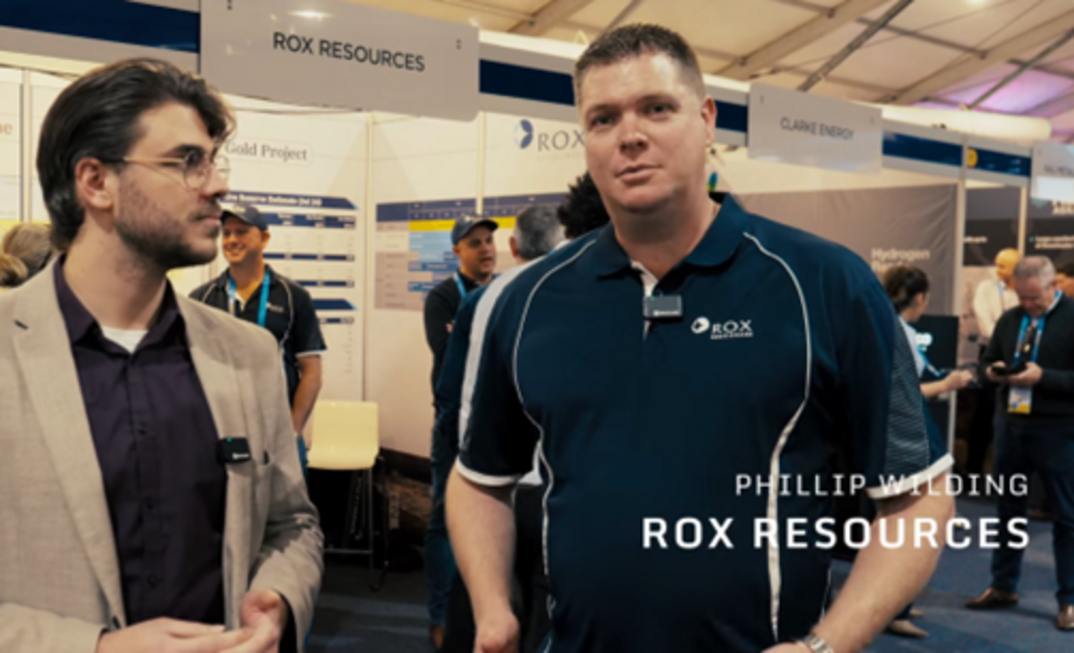


Gold developer Rox Resources has been quietly working away at its Youanmi project in Western Australia's Southern Cross region for more than half a decade, but as it approaches first gold, the stock is starting to get noticed.
"Everyone's looking for those next producers, and that's where Rox has really been getting a lot of attention," MD and CEO Phill Wilding told MNN on the sidelines of this year's Diggers and Dealers Mining Forum.
"Last year, no one knew about Rox. This year, we seem to be the talk of everybody."
The company has certainly kicked some goals, recently upgrading gold resources to 2.17 million ounces grading 5.6 grams per tonne, including an underground component of 2.1Moz at 6gpt.
YOU MIGHT ALSO LIKE
A July 2024 pre-feasibility study outlined a A$245 million development at Youanmi that could produce roughly 103,000oz of gold per year at all-in sustaining costs of $1676/oz over a 7.7-year mine life.
Assuming a gold price of $3100/oz, the PFS estimated a pre-tax net present value of $486 million and internal rate of return of 42%.
Gold prices have since climbed to above $5100/oz.
Rox is working on a definitive feasibility study, due in the December quarter of this year, to firm up Youanmi's economics.
The metallurgy question
A big question mark around Youanmi has been the refractory component of the ore and whether gold could be extracted in a profitable manner.
Rox plans to employ the ‘Albion Process' — a combination of ultra-fine grinding and oxidative leaching developed by Glencore in the ‘90s — at the project, and Wilding said metallurgical testwork had so far shown positive results.
Met tests for last year's pre-feasibility work, for example, showed average gold recovery to concentrate of 91%, with a mass recovery to concentrate of 13.5%.
Rox said as it works up the DFS process, it is estimating recoveries of 92.6%.
Other plants around the world have reportedly also seen success using the process.
"In Armenia, they built an [Albion Process] plant which is pretty much the exact size that we're going to build, 100,000t," Wilding said.
"That ran successfully from 2013 to 2020. It was a great plant — lots of papers on it. People who worked in that plant are working on our study, as well."
In fact, he said refractory ore was relatively common for many miners.
Wilding said Genesis Minerals had 2.1Moz of refractory ore and Northern Star's Super Pit had a refractory nature, as did De Grey's Hemi, recently acquired by Northern Star.
"Companies are not scared of this stuff, it's just that building the mills has been hard," he said.
"We've also heard a rumour — unconfirmed — that there are another couple of Albion plants being built internationally, which will probably actually start before ours. So, it's starting to get out there."
He said Rox comprised a team of mine builders who wanted to bring the potentially "industry-changing" processing technology to Western Australia themselves.
As is the common stance of most gold developers, he maintained that while possible dealers were certainly eyeing Rox over, the company wasn't positioning itself as a takeover play.
"From our side, we don't want to be taken over."
On the funding front, Wilding said some of the gold takeovers in the past year had taken away potential capital from financers.
"Banks are really looking for project financing deals … they're really wanting to deploy," he said.
"We're getting indicative terms sheets … with fantastic rates, no hedging requirements, and quite large gearing positions.
"We're pretty confident we're going to be able to get this thing off the ground without a massive amount of dilution and on really good terms."
Rox had $50 million in available cash at the start of August.
Shares in Rox were steady at 30c on Wednesday, capitalising the gold hopeful at $224 million. It traded below 15c per share this time last year.